Monday, May 30, 2011

Creative Commons Lab

     Photos and images are an excellent manner in which to bring new elements into a classroom.  I would use images to launch discussions regarding places of interest, geography, geology, as well as for writing prompts.  Depending on our current focus, the writing could focus on one of the five senses or emotion so students could absorb and interpret specific information without feeling overwhelmed.  Additionally, I would use images at the beginning or end of a unit to emphasize our learning.  Comparing and contrasting is another method that would be helpful for students to understand a certain concept.  With math, students would be able to see a visual representation of a concept.  For example, when teaching students about balancing equations, showing them a picture of a scale with two numbers on one side and another number of the other, they would be able to see what number was missing.  This would enable them to more fully grasp the concept and gain understanding.  With images in education, the possibilities are countless.

DSC_0096
Oregon Coast
Link to Flickr image: Justin Wright
Photographer's website: www.lifeofjustin.com
Creative Commons License
     Ah, the power of water and geology!  I originally had a great picture from Yellowstone National Park, but it disappeared.  :^(  So I found a different photo.  This picture of the Oregon coast was taken by Justin Wright.  The captions for his photos were all the same, but very liberal.  Therefore, I have done as he has requested and posted a link to his website.  I like this picture because of everything taking place all at once.  It is chaotic and beautiful.  What a site to visit, I would imagine.
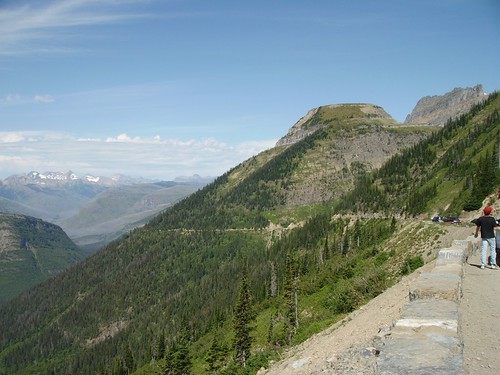
Going-to-the-Sun Road
Photo: Going-to-the-Sun Road, Glacier National Park, Montana
Taken by: Duane B. Karlin
Creative Commons License
This work is licensed under a Creative Commons Attribution-ShareAlike 3.0 Unported License.
     I took this picture last summer while in Glacier National Park, about 40 miles from my home.  Unfortunately, I visited the park on a weekend, so there was a lot of traffic and nowhere to park at the summit, so after literally driving in a circle for about 20 minutes, we turned around and drove back down to the valley.  Click on the picture description to see this one and others.

Saturday, May 28, 2011

UDL Guidelines

Having worked through the lab for Universal Design for Learning (UDL), I was intrigued by the questions it provoked in my mind.  Where I thought I had created a thoughtful lesson accessible to all learners, there were some areas that required some rethinking and reworking.  However, I also came to understand that many of the ideas I am attempting to teach with my lesson, "The Vicarious Travelers," already have many of the UDL Guidelines built into them.  As I continue with my education, I look forward to applying this knowledge with my classes to enable all students to achieve their best work without compromising standards.

UDL Guidelines – Educator Checklist Version 2

Your notes

Feature: enlarge text and pictures
Barrier: pictures are visual with no captions
Barrier: no text descriptions and/or captions available

Feature: learned about Rome, Italy on our virtual trip

Barrier: inability to read maps, interpret key symbols, and measure distance
Barrier: presented in English with little or no Italian background


Barrier: little background knowledge
Feature: math and social studies cross-curricular
Feature: comparing a foreign destination to a local area

Your notes

Barrier: not all students are proficient with computer research


Barrier: having students present their final presentations in the same format


Feature: learning about Italy and presenting the information
Barrier: need to encourage students to “stop and think” to solve a problem
Barrier: need to provide a checklist of what students will need to “discover”
Feature: provides feedback during the course of the lesson
Your notes

Barrier: provide students with alternative website they may be more familiar with to locate their information
Feature: students will understand how to calculate distance based on what they learned and apply it to where they live
Feature: stretch the lesson into several days with goals for each day so students do not feel overwhelmed


Feature: have students collaborate and share their information with another student for suggestions and feedback
Feature: providing feedback

Barrier: provide a rubric

Barrier: provide students with a chart so they can see their progress

© CAST 2011